
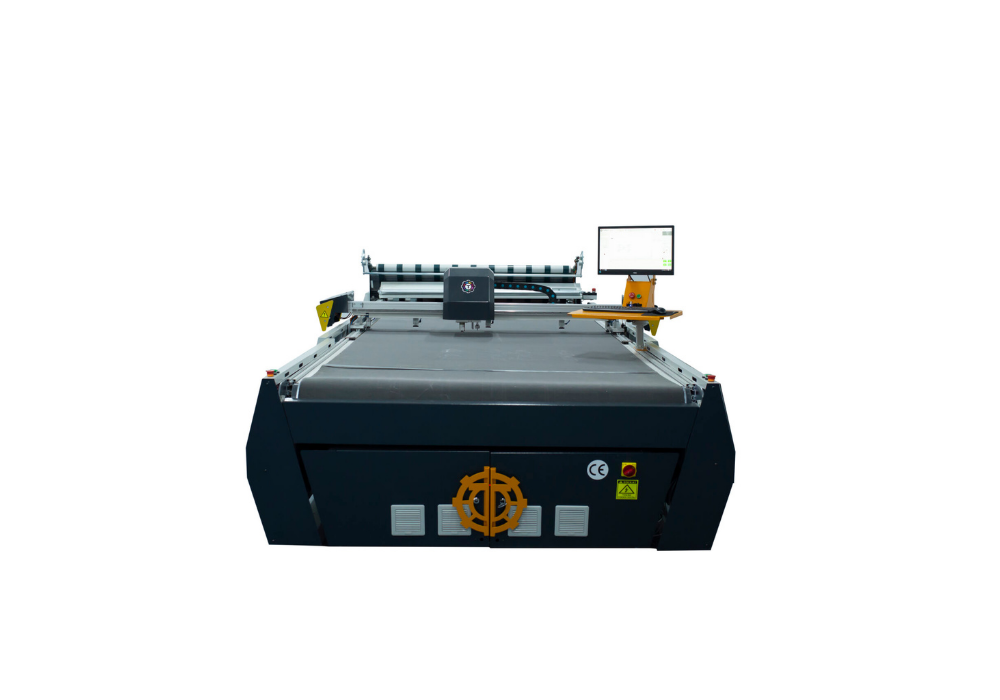
TUNCA AUTOMATIC CUTTING MACHINE

-
Meeting of Quality and Technology in Domestic Production
For many years, the cutting machines needed in the textile industry were either imported or limited to low-tech solutions. However, this has changed. Domestically produced cutting machines are being developed. TUNCA CNC Fabric Cutting Machine, It shows how quality can be blended with technology.
Not only is this system manufactured in Turkey, but it also boasts an engineering infrastructure that meets global standards. In other words, it effectively ends foreign dependency in the textile sector.
The most important thing manufacturers focus on is the level of precision this device offers. But what is the secret to such precise and error-free cuts?
Now in the next section we will look at the heart of this system. CNC teknolojisinin bu başarılardaki rolü ele alınacaktır…
-
Millimetric Accuracy in Cutting with CNC Technology
Correcting errors in fabric cutting is often very costly. Therefore, every millimeter counts. The TUNCA CNC Cutting Machine exceeds this expectation of precision.
CNC (Computer Numerical Control) teknolojisiyle donatılan sistem, her bir kesim hareketini önceden programlanmış verilere göre gerçekleştirmektedir. Bu da her defasında aynı sonucu veren, standarttan sapmayan bir kesim süreci anlamına gelmektedir.
Not only straight cuts but also complex patterns, ovals, and special shapes can be executed with equal precision. This precision reduces the error rate during post-production inspections to virtually zero.
However, such accuracy alone isn't enough. Productivity can't be achieved without speed and repeatability. At this point, it's necessary to take a closer look at the impact of automation on cutting.
-
Contribution of Automation to Fabric Cutting
The TUNCA CNC Cutter is not just a cutter; it should also be considered an intelligent production partner. Thanks to the integration of automation into the process, cutting operations can now be completed without the need for manual intervention.
All parameters, such as cutting sequences, speed settings, and blade directions, are determined by the system, leaving the operator with only oversight. This reduces labor costs and increases production capacity.
Moreover, the margin of error decreases significantly as the human factor is reduced. When the process is standardized, quality control becomes more meaningful, and every product can be produced identically.
However, the system's success isn't just due to automation. Its compatibility with different fabric types is also crucial. But can this device achieve the same success with every fabric?
-
Compatible with Different Thicknesses and Types of Fabric
Not all fabrics are cut the same. Thin silk fabric and thick felt don't behave the same. However, the TUNCA CNC Cutter was specifically developed to overcome this challenge.
Adjustable blade pressure levels, speed modes, and sensor-controlled feed systems allow for instant adaptation to fabrics of varying thicknesses. Once the manufacturer selects the fabric type, the system adjusts itself accordingly, activating compensating tables if necessary.
Cotton, polyester, denim, wool, artificial leather, even technical textile types… All of them can be cut successfully by this system.
But the question that comes to mind here is: Is this device only suitable for small-scale manufacturers, or can it also provide a solution for large factories?
The answer to this question will become clear in the next section…
-
Suitability for Industrial-Scale Production
Textile businesses engaged in industrial production require hundreds of meters of fabric to be cut in a matter of hours. Under this intense workload, maintaining system performance is crucial. This is where the true power of the TUNCA CNC Cutter comes into play.
Thanks to the motors that do not overheat during long periods of operation, the special cooling systems of the blades and the automatic cleaning module, the machine is ideal for uninterrupted and mass production.
In addition, the width of the feeding table makes it a complete industrial solution thanks to its structure suitable for working with bulk fabric rolls.
However, maintenance has always been a question mark during intensive use. Does the ease of maintenance of this system reduce the burden on the user? This issue will be clarified in the next section.
-
Ease of Maintenance and Spare Parts Support
One of the biggest problems that can occur with cutting machines is the disruption of the process after a malfunction. However, the TUNCA system anticipates this risk and offers highly practical solutions for maintenance and spare parts.
Thanks to the modular structure, faulty parts can be easily detected and replaced, and thanks to user-specific video-supported maintenance guides, many operations can be performed without calling an external service.
In addition, Tunca Makine's widespread technical service network throughout Türkiye and instant supply of spare parts ensure production continuity.
Of course, another important value this system adds to a business is energy efficiency. So, can such a powerful system also be competitive in energy usage?
-
Energy Efficiency and Labor Reduction
Textile cutting processes are often associated with high energy consumption. However, in the TUNCA CNC Cutter, energy use is minimized with low-consumption motors and intelligent standby modes.
The machine uses full power only during active cutting and switches to energy-saving mode at all other times. This feature significantly reduces energy bills and helps control operating costs.
Additionally, the reduction in labor requirements directly impacts profit margins. Instead of multiple operators, full system control can be achieved with just one person, reducing operator load and reducing the likelihood of human errors.